
Friends from the Necropolis
A morbid half-joke and only half a joke: It's great to be alive in Colma.

When I run into questions, I visit the cemetery to see how the dead are doing.
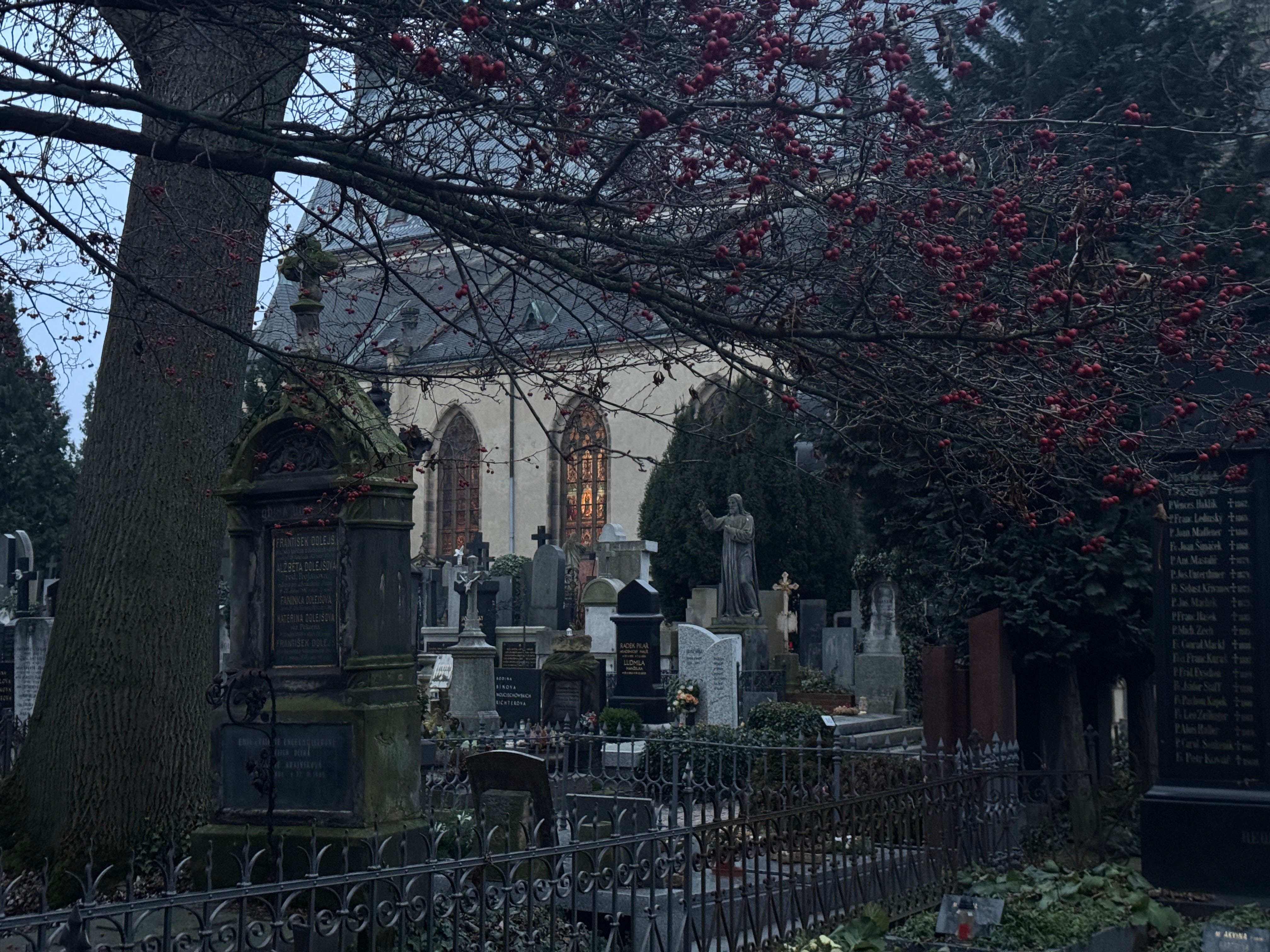
The dead are doing just fine, as they were last time and the time before. I guess that is to be expected of them.
The first thing I do in Vyšehrad cemetery is to greet my old friend, Antonín Dvořák. Dvořák is not quite my favourite of the composers (that spot may partially be taken by Rachmaninoff or Messiaen, or holistically by Ligeti), but I do happen to be a classically-trained musician living in his country. That would be sufficient for me to consider him a friend from the necropolis.
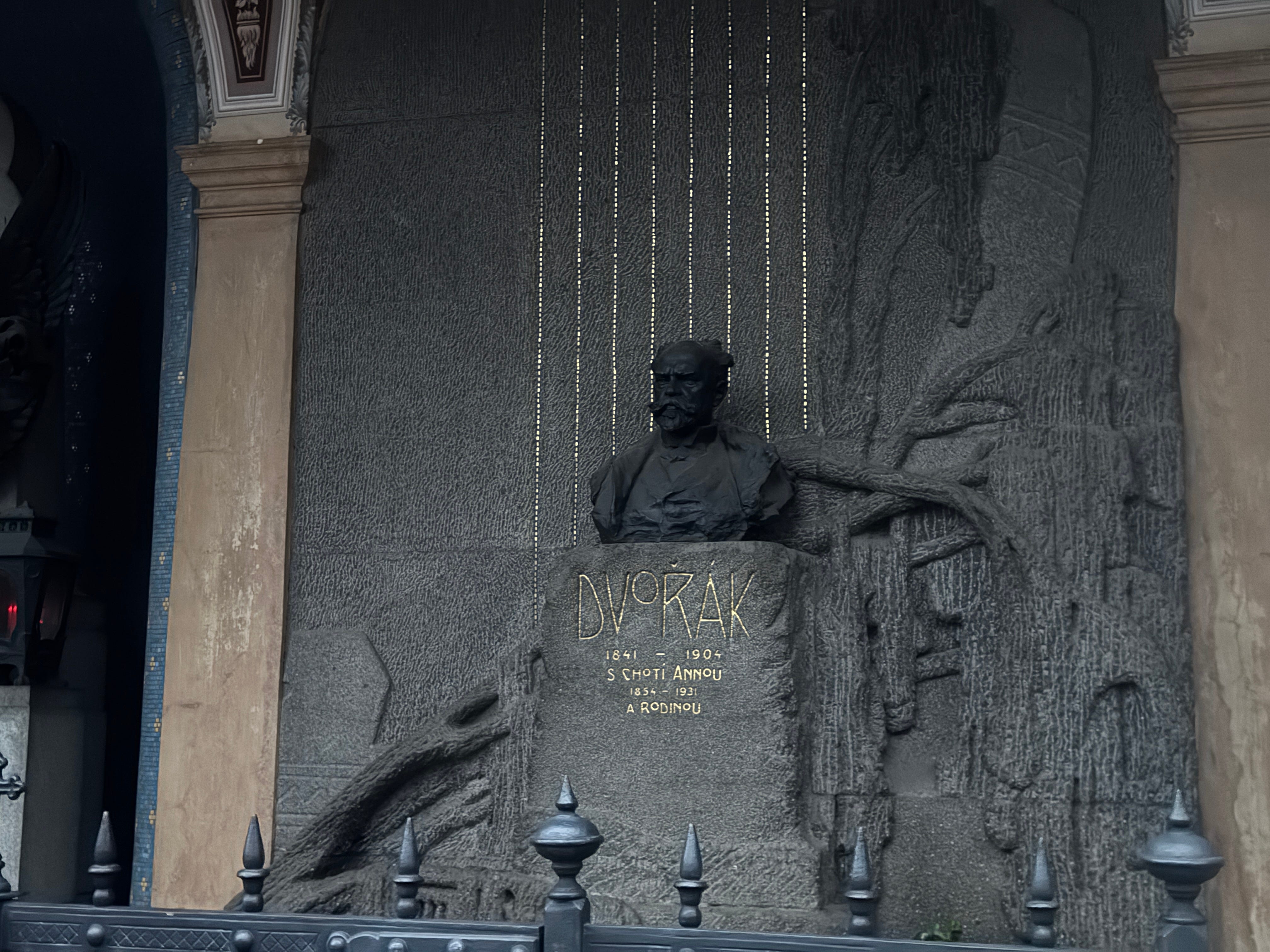
Vyšehrad cemetery is as high-society as it gets: a small, intimate attachment to a neo-gothic basilica, sitting on top of a medieval fort and housing the Slavín Tomb — a Czech equivalent of the Panthéon. It is a national cemetery that buried artists, intellectuals and other individuals significant to Czech culture and society — making a walk through the cemetery somewhat akin to being introduced to the participant of an extremely posh, albeit partially involuntary dinner party. Smetana, the other (and prior) giant of Czech National-Romantic music, happens also to be buried in Vyšehrad — as I later discovered. Dvořak introduced me to Smetana, though I can’t recall whether it was musically or physically by this point.
Back in England, I liked to visit the Brompton cemetery. It buried the heroes, the commoners, but most prominently, the dead of WWI. Not all are military burials — those exist mainly in France and Belgium, along what was the Western Front. More often, they were young servicemen who fell from injury and disease after being sent home, be it just shortly or from the subsequent Spanish flu. Most were about my age — not much over 20, if that at all.
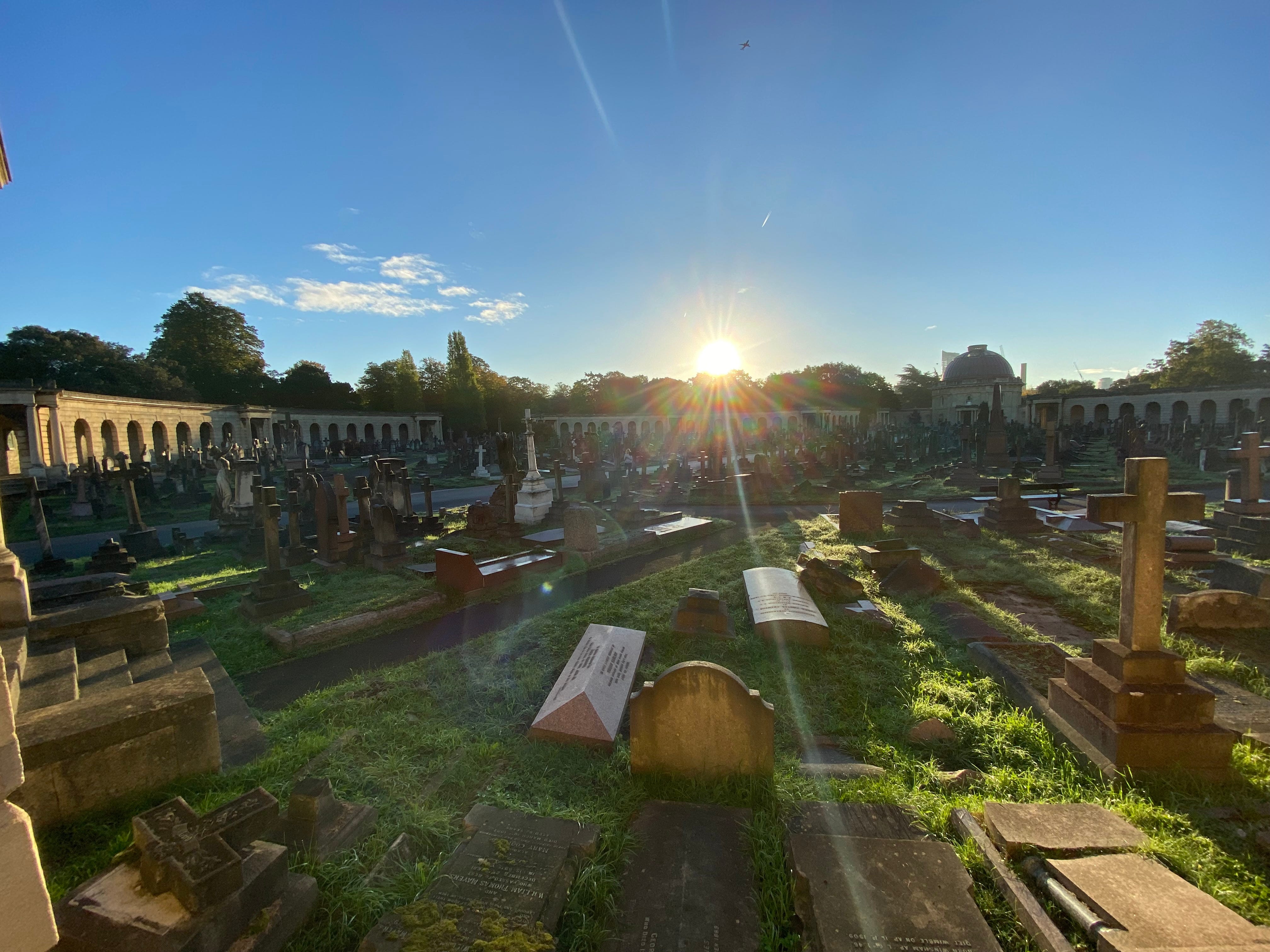
I would arrive at dawn, before the arteries and intestines of London begins its daily congestion, and read my war history books under the watch of those troopers. The Pacific War, the Deluge, the Great War, the neverending wars. From Sun Tzu (strategy in its most war-like analogue form) to Lykke (its most theoretical refinement). Do I know more about war having read dozen after dozen books, than they do having lived, enlivened and died from it? Would I, if I were born in a country honourable enough for me to enlist and serve its purpose?
I don't, and I will never — the only way to know as much as the dead is to have died in the same manner they did. There is only one manner you could die in; and being amongst the living, the only way one could prophecise how is by having willed it.
Very few will their own death, and even fewer will their own death by war — unless you are Mishima (the refined, intellectual version of a jihadist) or a jihadist (the brute, kinetic version of Mishima). Outside of that very small subset of mankind, it holds true that the purpose of war is precisely for one to not die — be one the individual, or the agentic homeland he committed his own life to defend. It hold as true to me, as it does to the British troopers six-foot under. I don’t know who they are, but they are my friends from the necropolis — their mere presence teaches me what I cannot possibly know. I would like to think they’d also appreciate being visited, considered, seen.
I guess that’s what friends are for, at the end of the day.
And sometimes I would think about Colma.
Colma (CA) is a small incorporated town just outside of San Francisco, commonly known as the modern necropolis. It houses about 1500 of the living, and some million and a half of the dead — which makes it rather convenient for the sort of morbid half-jokes that get retracted for controversy as soon as they were made.
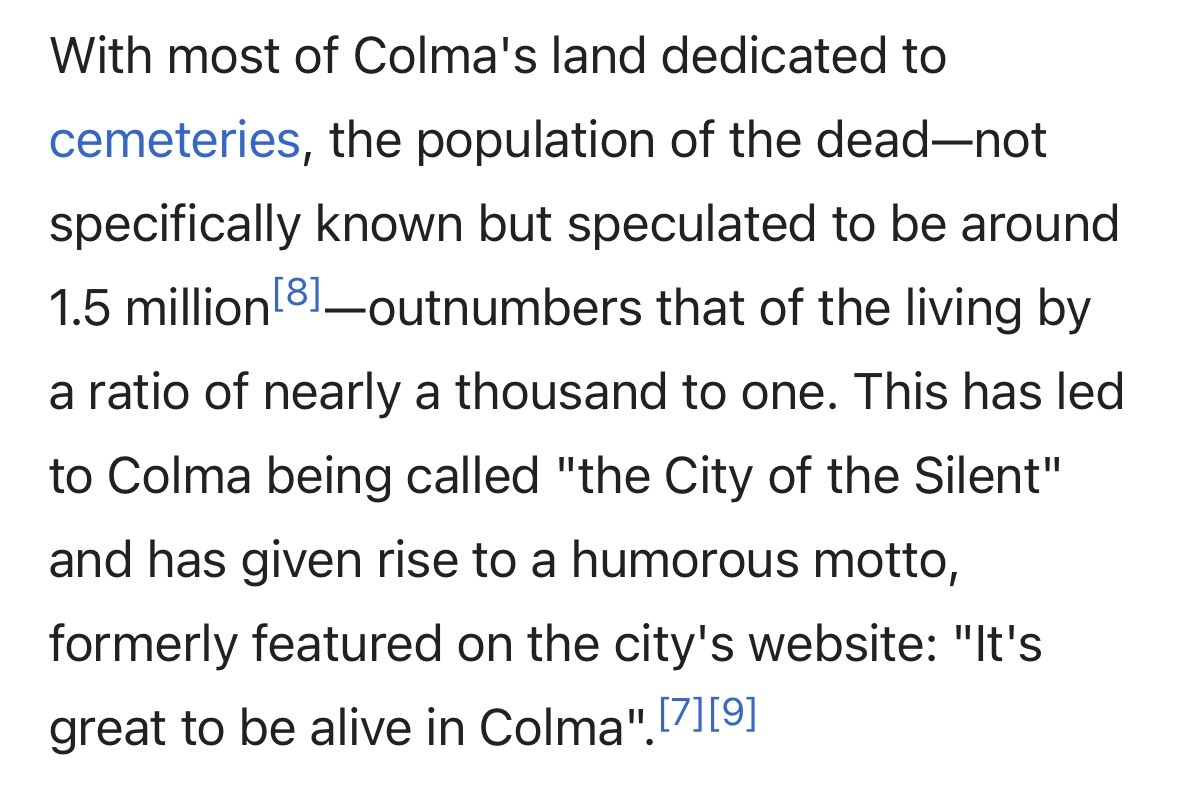
A friend of mine (this time a perfectly living one, in case you wonder) once half-joked about taking me around Colma. It is a somewhat amusing idea to be in a physical necropolis, built by the living for the dead — as opposed to your average polis, built by dead for the living. An inverse-city.
But it doesn't serve my purpose: I was never in the necropolis to look for headstones — I go there to look for company, the same way I go to school, dinner parties, empty dockyards, digital forums — to look for company. By what are people, what were people, and objects that either inspired or actualised the contents of the minds of what are and what were people. Some call it spirits, and others call it information.
I shall visit Shannon some day. I see him every day, if not every other moment (now that I’m in the app-building business — blame Anthropic); but it would be nice to pay the lad a formal visit at his resting place.
But I am already in Colma. No more lost, and no more found than I would be in Prague, London or San Francisco. For that matter, the world is just one big Colma — poleis and necropoleis stacked on top of one another. The physical necropolis is a type of polis, but every polis is built on remnants of some necropoleis. The necropolis is just what's perceivable of the previous polis. Neither is surprising in their presence: you don’t see someone on the metro and exclaim to yourself ah, here’s a live person!, just as you wouldn’t exclaim ah, here’s a dead person! in Colma. Everyone is somewhat alive and somewhat dead.
The biologist would object to that proposition: everyone is alive until they’re not. There is a strict cybernetic definition behind what counts as “alive”: the organism must possess the ability, under the given circumstance, to maintain its own status as an organism. It is what von Bertalanffy (a Platonic entity I reconstructed from excerpts of Robots, Men and Minds) would call the zoomorphic definition of life.
Under the same cybernetic principle, the ideologist considers everyone alive until they are no longer considered. Forgotten. The identity — the coherent totality of one’s ideas — must possess the ability, under the given circumstance, to maintain its own status as an identity. It is what von Bertalanffy would call the anthropomorphic definition of the definition of life.
In Colma, neither of them matter as much as they think they do. All they depict are pathways of decay — for any entity, concrete or abstract, to go from alive to dead. From significant to incoherent. There are countless ways to be dead in Colma: Some are alive despite being dead. Some are dead despite being alive. The priors cannot prevent from the latters from further killing them, nor can the latters prevent the priors from killing more of them.
Being dead in Colma is the default: it means being predisposed towards being lost.
Meanwhile, the only condition to being alive in Colma is knowing that one is in Colma.
It is great to be alive in Colma.
Thank you for reading. For those of you who knew me from my geopolitical commentaries — yes, this is still the same old Juno. My politics hadn’t changed, nor did they stop mattering to me; but I figured I have better things to offer here than just another piece of internet activism. Instead, I will deploy my activism towards the more concrete domains. I may or may not tell you about them, but it doesn't matter all that much at the end of the day. God is watching either way.
L’chaim.